 By Sanjeev Sinha
 If you’re planning a Hampi trip, chances are you’re mentally preparing for ancient temples and boulder-strewn landscapes, not a modern dam. But skip Tungabhadra Dam and you’ll miss a genuinely fascinating story — one that started with a devastating famine, took eighty years of political back-and-forth to resolve, and ended up creating the water lifeline that still irrigates farmland across Karnataka and Andhra Pradesh today. If you’re already in Hampi, this is one detour that’s absolutely worth the extra half-day.
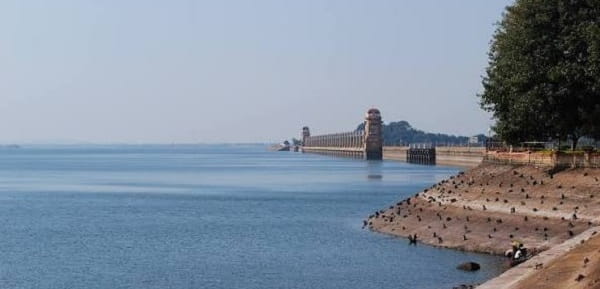
Tungabhadra Dam Quick Overview
| Detail | Information |
| Also Known As | Pampa Sagar |
| River | Tungabhadra River, a tributary of the Krishna River |
| Location | Munirabad, near Hosapete (Hospet), Karnataka |
| Distance from Hampi | Around 19–20 km |
| Nearest Railway Station | Hospet Junction, about 6–7 km away |
| Nearest Airport | Jindal Vijaynagar Airport, roughly 42 km away |
| Famine That Triggered the Idea | 1860, Rayalaseema region |
| Foundation Laid | 28 February 1945 |
| Completed | 1953 |
| Dam Height | Around 49.5 metres |
| Dam Length | About 2,449 metres |
| Reservoir Capacity | 101 TMC |
| Catchment Area | Around 28,000 sq. km |
| Crest Gates | 33 |
| Power Generation | 126 MW combined across three powerhouses |
| Irrigation Coverage | Over 2 lakh hectares across Bellary, Raichur, and Koppal |
| Visiting Hours | Generally 9:00 AM to 8:00 PM |
| Entry Fee | Around ₹10 per person |
| Light and Sound Show | Daily, roughly 7:15 PM to 8:30 PM |
Where Tungabhadra Dam Is Located
Tungabhadra Dam sits in Munirabad, close to Hosapete, roughly 19 to 20 kilometres from Hampi’s ancient ruins. It’s positioned right near National Highways 50 and 67, making it easily accessible whether you’re coming from Hampi’s temple complex or directly from Hosapete town.
Getting here from Hampi is straightforward — rental bikes, auto-rickshaws, buses via the Hosapete bus stand, or a hired taxi all work well. If you’re travelling by rail, Hospet Junction is your closest station at just 6 to 7 kilometres away, and there’s even a dedicated Tungabhadra Dam Railway Station nearby, though it only sees a handful of passenger trains daily, so it’s not the most practical option for most visitors.
The River Behind This Massive Reservoir
The dam is built across the Tungabhadra River, itself a tributary of the Krishna River, and one that flows almost entirely within Karnataka before crossing into Andhra Pradesh. The reservoir it creates, poetically known as Pampa Sagar, spans a catchment area of roughly 28,000 square kilometres and holds up to 101 TMC of water.
This isn’t just a scenic body of water — it’s the backbone of three separate canal systems that stretch out for hundreds of kilometres. The Tungabhadra Canal alone runs 340 kilometres, irrigating farmland across Raichur and Mahbubnagar, while the Low-Level and High-Level canals extend the reach even further into Bellary, Kurnool, and Anantapur districts.
A History Shaped by Famine and Decades of Negotiation
The story behind Tungabhadra Dam begins in 1860, when a severe famine struck the Rayalaseema region, an area covering Bellary, Anantapur, Kurnool, and Kadapa. That crisis planted the idea of building a major dam to secure irrigation and prevent future disasters of this scale.
But turning that idea into reality took an extraordinarily long time. Since the river’s banks fell under two separate political territories, the Madras Presidency and the Hyderabad Kingdom, the project required roughly eighty years of studies, negotiations, and disputes before construction could even begin. The formal inauguration finally happened on 28 February 1945, with Nawab Azam Jha, the Prince of Berar, laying the foundation stone on one side of the dam, and Baron Sir Arthur Hope, then Governor of Madras, laying the foundation on the other.
Construction continued through the transition of these territories into the modern states of Karnataka and Andhra Pradesh, and the dam was finally completed in 1953. Interestingly, some historical accounts trace the region’s irrigation ambitions even further back, suggesting elements of canal networks may have existed here as far back as the Vijayanagara era, with King Devaraya reportedly building an early water-management structure across the same river in the early 15th century.
What Powers and Irrigates This Region
Tungabhadra Dam’s multipurpose design means it does far more than just hold back water. Three separate powerhouses draw from the reservoir — one at Munirabad generating 27 MW, a larger facility at Hospet with eight units producing a combined 72 MW, and a third near Hampi contributing another 27 MW, bringing the total to 126 MW used for irrigation support and powering small and cottage industries in the region.
On the irrigation side, this dam supports agriculture across more than 2 lakh hectares, making it an absolutely critical piece of infrastructure for farmers in Bellary, Raichur, and Koppal districts, and extending benefits into parts of Andhra Pradesh as well.
What There Is to See and Do
Beyond the engineering itself, the dam complex has developed into a genuinely pleasant recreational stop. Nandanavana Garden, built just downstream of the dam, offers manicured lawns, flower beds, and fountains, while the nearby Japanese Park adds ponds, flowering trees, a musical fountain, and even a small aquarium. A Deer Park functions as a mini zoo, home to various deer species alongside rabbits and porcupines, and the reservoir itself attracts a good variety of birds, including peacocks and parrots.
Boating on the reservoir gives visitors a different perspective of the dam’s scale, and sunset here is genuinely one of the highlights, with the structure taking on a warm golden glow during the evening hours. If you’re around after dark, the daily light and sound show, running roughly from 7:15 PM to 8:30 PM, illuminates each of the dam’s 33 crest gates in different colours, creating a striking visual display against the night sky.
Timings and Entry Details
Most sources place general visiting hours between 9:00 AM and 8:00 PM, with entry priced at a modest ₹10 per person. Keep in mind that the dam itself often sits about a kilometre from the main entrance gate, and while a shuttle bus service is sometimes available for around ₹30 per person, it typically only runs once enough visitors gather, so be prepared to walk if numbers are low.
Note that the dam is not accessible to visitors at night beyond the light and sound show window, so plan your visit within the standard daytime hours.
Best Time to Plan Your Visit
Monsoon season, from June to September, is widely considered the best time to witness the dam at its most dramatic, with water gushing through the gates in full force once the reservoir fills up. That said, October through March offers more comfortable weather for general sightseeing and garden walks, if witnessing the spillway in action isn’t your main priority.
Frequently Asked Questions
Q: Can I combine a Tungabhadra Dam visit with Hampi sightseeing in one day?
A: Yes, comfortably. At around 19 to 20 kilometres from Hampi, most visitors treat this as a half-day extension to their Hampi itinerary, especially if they’re already using a rented bike or hired taxi for the day.
Q: Is the walk from the entrance to the dam manageable for most visitors?
A: It’s roughly a kilometre, which is manageable for most people, though it can feel long in hot weather. A shuttle bus is sometimes available, but it depends on enough visitors gathering, so be prepared to walk if needed.
Q: What’s the best time of day to visit for the light and sound show?
A: Arrive by early evening, ideally before 7:00 PM, to explore the gardens and dam in daylight first, then stay on for the show, which typically runs from around 7:15 PM to 8:30 PM.
Q: Is boating available year-round at the Tungabhadra reservoir?
A: Boating and activities like fishing generally depend on water levels, so they’re most reliably available post-monsoon and through winter, when the reservoir is fuller. It’s worth checking current conditions if this is a priority for your visit.