 By Sanjeev Sinha
 Ask any Mumbaikar or Punekar what the first rain of the season means to them, and there’s a good chance “Bhushi Dam” comes up within the first two sentences. This isn’t your typical quiet reservoir — it’s the place where entire families, college gangs, and honeymooning couples all end up soaked to the bone, laughing on wet stone steps while gushing monsoon water rushes past their feet. If you’re planning a Lonavala trip anytime between June and September, understanding Bhushi Dam properly — what it actually is, where it sits, and how to visit it safely — makes the difference between a great day out and a risky one.
Here’s the complete, practical picture.
| Detail | Information |
| River | Indrayani River |
| Location | Near Lonavala, Pune district, Maharashtra |
| Distance from Lonavala Railway Station | Around 5–6 km |
| Distance from Pune | Roughly 64–70 km |
| Distance from Mumbai | About 88–100 km |
| Nearest Airport | Pune International Airport (~70 km) or Mumbai’s Chhatrapati Shivaji Maharaj International Airport (~95–100 km) |
| Dam Type | Masonry dam |
| Built | Late 1860s, by the Great Indian Peninsula Railway |
| Original Purpose | Supplying water to steam locomotives on the Mumbai–Pune railway line |
| Current Ownership | Indian Railways |
| Reservoir Name | Bhushi Lake |
| Visiting Hours | Generally 9:00 AM to 5:00 PM; area typically closes by 6:00 PM |
| Entry Fee | Free |
| Best Time to Visit | July to September (monsoon), with winter as a calmer alternative |
Where Bhushi Dam Is Located
Bhushi Dam sits just 5 to 6 kilometres from Lonavala Railway Station, tucked into the Sahyadri hills of the Western Ghats in Pune district. It’s close to INS Shivaji, and getting here from either Mumbai or Pune is a straightforward drive along the Mumbai-Pune Expressway or the older NH48 highway, with clear local signage pointing you toward the dam once you’re near Lonavala town.
If you’re travelling by train, Lonavala station connects well with both Mumbai and Pune on regular express services, and from there, a short taxi or auto-rickshaw ride gets you to the dam within fifteen to twenty minutes.
The River Behind the Dam
Bhushi Dam is built across the Indrayani River, one of the region’s notable waterways that eventually flows through Pune district before joining larger river systems downstream. In its everyday role, the dam and its reservoir, known as Bhushi Lake, support local water needs and even contribute to power generation through Tata Power’s infrastructure in the region.
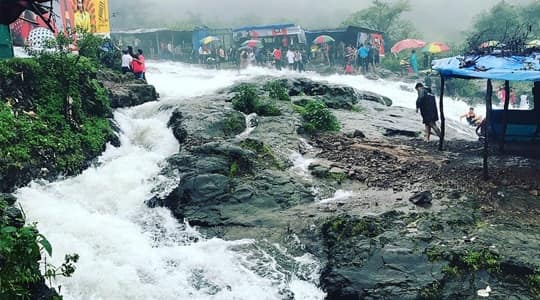
But let’s be honest — almost nobody visits Bhushi Dam thinking about its role in the local water system. What draws the crowds is what happens when the reservoir overflows during monsoon, sending water cascading down a series of wide stone steps in a way that turns the entire area into a natural, open-air water park.
A History Rooted in the Railways, Not Tourism
Here’s something most visitors don’t realise — Bhushi Dam wasn’t built with tourism in mind at all. It was constructed in the late 1860s by the Great Indian Peninsula Railway, purely as a water source for steam engines operating on the Mumbai-Pune line. Cast-iron pipes once carried water from this dam to Lonavala, Khandala, and the railway’s reversing stations nearby.
As steam locomotives gradually disappeared from Indian Railways, the dam’s original function faded into irrelevance. What replaced it was something nobody quite planned for — the site slowly transformed into one of Lonavala’s most beloved recreational spots, purely because of how naturally fun its overflow steps turned out to be. Indian Railways, which still technically owns the site as successor to the GIPR, reportedly explored formal plans around 2014 to develop it further as a tourist destination, building on what had already become an organic, word-of-mouth attraction.
Why the Monsoon Season Changes Everything
During the dry months, Bhushi Dam looks fairly ordinary — a modest masonry structure with calm water behind it. The transformation happens once the monsoon sets in seriously, usually by July. As the reservoir fills beyond capacity, water spills over a set of broad stone steps, each roughly a metre to a metre and a half high, spanning a stretch of about 50 metres.
That combination of moving water, natural rock, and manageable depth on the steps is exactly why this spot has become such a magnet for families with children, groups of friends, and pretty much anyone looking for a low-effort, high-fun monsoon outing. Snack stalls selling hot bhaji-pav and chai line the area, adding to the festive, mela-like atmosphere that builds up especially on weekends.
Safety Rules You Genuinely Need to Follow
This is the part that deserves real attention, not just a passing mention. Swimming at Bhushi Dam has always been officially prohibited, given how unpredictable the water flow can get, especially during heavy rainfall when currents strengthen without warning. Visitors are encouraged to stick to sitting or wading on the steps rather than venturing into deeper or faster-moving sections.
As of 2026, local authorities have also tightened rules around the site. Visitors are generally required to be out of the water by 5:00 PM, with the entire area closing by 6:00 PM, partly due to its proximity to forested terrain. Alcohol and loud music systems have also been banned to keep the environment family-friendly and reduce safety risks. During periods of particularly heavy rainfall, district authorities may impose temporary access restrictions altogether, so checking local updates before setting out during peak monsoon weeks is a genuinely smart move.
Timings and Entry Details
Bhushi Dam is open daily, generally from around 9:00 AM to 5:00 PM, with the broader area typically clearing out by 6:00 PM under current local guidelines. There’s no entry fee to access the site, making it an easy, budget-friendly addition to any Lonavala itinerary. You’ll only spend money on parking, snacks, or optional extras like renting a raincoat or plastic sheet from nearby vendors.
Weekends and public holidays during monsoon see the heaviest crowds by a significant margin, so arriving early in the morning genuinely helps if you want breathing room on the steps rather than shoulder-to-shoulder crowding.
Best Time to Plan Your Visit
July through September remains the prime window, when the dam is at its most dramatic and the surrounding Sahyadri hills turn a deep monsoon green. If you’d rather skip the crowds entirely, winter months offer a calmer, quieter version of the same scenic backdrop, minus the overflow spectacle. Either way, weekday visits tend to be noticeably less chaotic than weekends, particularly if photography or a relaxed family outing is your priority.
Frequently Asked Questions
Q1. Is it actually safe to sit in the water at Bhushi Dam?
It can be, as long as you stay on the designated steps within manageable flow zones, avoid standing in the strongest current, and wear footwear with good grip. Swimming itself is prohibited due to unpredictable water behaviour, especially during peak monsoon.
Q2. Do I need to book tickets in advance to visit Bhushi Dam?
No, entry is completely free with no advance booking required. You simply show up during operating hours, though arriving early on weekends helps you avoid the worst of the crowd.
Q3. What’s the best time of day to visit for fewer crowds?
Early morning, right after the site opens around 9:00 AM, is your best bet for a relatively peaceful experience before weekend crowds build up through the late morning and afternoon.
Q4. Can I visit Bhushi Dam outside monsoon season?
Yes, but the dramatic overflow and water-step experience is specific to monsoon months, roughly July to September. Outside this window, the dam looks calmer and more like a standard reservoir, which some visitors actually prefer for quieter sightseeing.