 By Sanjeev Sinha
 Ask any Indian above the age of 50 about Bhakra Nangal, and you’ll likely hear it described as “the dam that changed Punjab and Haryana forever.” That’s not an exaggeration. This one structure is the reason wheat fields across three states get reliable water even in dry years, and it’s the reason millions of homes in North India have had steady electricity for decades. Nehru himself called it “the temple of resurgent India,” and once you understand what this dam actually does, that description makes complete sense. For travellers headed to Himachal Pradesh’s Bilaspur district, it’s also one of the most impressive engineering sights you’ll come across — provided you know what to expect before you go.
Here’s a clear, practical breakdown of everything worth knowing.
| Detail | Information |
| River | Sutlej River |
| Location | Bhakra village, Bilaspur district, Himachal Pradesh |
| Distance from Bilaspur Town | Around 100–106 km |
| Distance from Nangal Town (Punjab) | About 15 km |
| Reservoir Name | Gobind Sagar |
| Construction Period | Started 1948, completed 1963 |
| Inaugurated By | Jawaharlal Nehru, 1963 |
| Dam Type | Concrete gravity dam |
| Dam Height | Around 226 metres (740 feet) |
| Dam Length | About 518 metres (1,700 feet) |
| Ranking | Second tallest dam in Asia, one of the tallest gravity dams in the world |
| Power Generation Capacity | Roughly 1,325–1,500 MW |
| Irrigation Coverage | About 10 million acres across Punjab, Haryana, Rajasthan, and parts of Gujarat and Himachal Pradesh |
| Visitor Access | Historically restricted since 2009 for security reasons; check current status before visiting |
| Best Time to Visit | October to March |
Where Bhakra Nangal Dam Is Actually Located
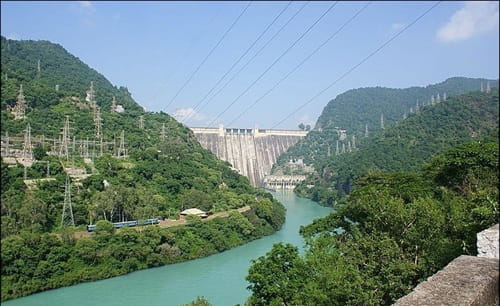
Bhakra Dam sits at Bhakra village in Bilaspur district, Himachal Pradesh, right where the Sutlej River cuts through a narrow gorge. Downstream, roughly 15 kilometres away in Punjab, sits the smaller Nangal Dam. Technically, these are two separate structures — Bhakra holds back the Sutlej to create the massive Gobind Sagar reservoir, while Nangal acts as a regulating dam that channels released water toward the Ganguwal and Kotla power stations. Because they function as one integrated system, people almost always refer to them together as “Bhakra Nangal.”
If you’re travelling from Bilaspur town, expect a drive of about 100 kilometres. Coming from Punjab’s side, Nangal town is your closest access point, and Anandpur Sahib, an important Sikh pilgrimage centre, is also within easy reach and often combined with a Bhakra Nangal visit.
The River Behind This Engineering Giant
The Sutlej River is what makes all of this possible. Originating in Tibet and flowing through Himachal Pradesh into Punjab, the Sutlej carries a massive volume of water, especially during monsoon and snowmelt season. Before the dam existed, this same river caused devastating floods across Punjab’s plains almost every year.
By damming the Sutlej at Bhakra, engineers created Gobind Sagar, a reservoir so large it ranks among the top three by storage capacity in the entire country. That stored water doesn’t just sit there for scenery — it’s released in a controlled manner throughout the year, which is precisely why farms across Punjab, Haryana, and Rajasthan no longer depend entirely on unpredictable monsoon rains.
A History Rooted in Independence-Era Ambition
The idea for this dam predates Indian independence by decades. Sir Chhotu Ram, often called the father of the Bhakra Dam concept, first proposed it back in 1923. The formal agreement was signed with the Raja of Bilaspur in November 1944, and the project plan was finalised in January 1945 — meaning this dam was conceived while India was still under British rule.
Actual construction began in 1948, shortly after independence, and Nehru himself poured the first bucket of concrete into the dry riverbed in 1955 as a symbolic gesture. It took until 1963 for the project to be fully completed and dedicated to the nation. In the process, around 371 villages across Bilaspur district were submerged to create the reservoir, displacing a significant population — a resettlement issue that, even decades later, has occasionally resurfaced in local discussions.
What Nehru said at the dedication ceremony still gets quoted often: he described the dam as something worthy of worship, comparing it to a temple, a gurdwara, or a mosque, built through the toil of ordinary people for the benefit of the nation.
Why This Dam Matters Beyond Sightseeing
It’s easy to look at Bhakra Nangal purely as a tourist attraction, but its real significance lies in three areas. First, irrigation — the Bhakra Canal system waters close to 10 million acres of farmland, effectively transforming Punjab and Haryana into India’s wheat and rice belt. Second, power generation — with a capacity running into the thousands of megawatts, it supplies electricity to Punjab, Haryana, Himachal Pradesh, Chandigarh, and Delhi. Third, flood control — by regulating the Sutlej’s flow, it has significantly reduced the flooding that once plagued the region during heavy monsoons.
There’s also a lesser-known detail that surprises most visitors: the Bhakra–Nangal Railway, a narrow-gauge line connecting the two dam sites, remains one of the only railway lines in India where passengers travel completely free of charge.
Visitor Access: What You Need to Know Before Planning a Trip
This is where things get genuinely important, and where different sources disagree. Several travel platforms describe visiting hours, boating activities, and viewing points as though the dam is freely open to tourists, with listed timings varying anywhere from 10 AM to 5 PM on some sites, to 8 AM through 6:30 PM on others. However, other sources, including Wikipedia, note that public visitor access to the dam structure itself has been restricted since 2009 due to security concerns, given the dam’s strategic and national importance.
In practical terms, this means the experience today often centres more around distant viewpoints, the Gobind Sagar reservoir, and nearby attractions like Naina Devi Temple, rather than close-up access to the dam wall itself, which may require prior permission depending on current security protocols. Given how much this varies by source and how sensitive dam security policies can be, it’s genuinely worth checking with local authorities or your hotel in Bilaspur or Nangal right before your trip, rather than relying on any single listed timing online.
Making the Most of Your Visit
Assuming current access allows it, the best time to visit is between October and March, when the weather stays cool and comfortable for sightseeing. The Gobind Sagar reservoir offers boating and fishing opportunities, and the surrounding hills are excellent for birdwatching, particularly in winter.
Nearby, Naina Devi Temple sits on a hilltop overlooking the lake and is accessible either by cable car or a trekking route — a popular add-on for most visitors. History enthusiasts often extend the trip to Vyas Cave, associated with the sage believed to have composed the Mahabharata, or Bahadurpur Fort, a 17th-century structure with its own regional significance.
Frequently Asked Questions
Q1. Can tourists actually go inside or walk on top of Bhakra Dam?
Close-up access has been restricted since 2009 for security reasons, according to several sources, though exact current rules vary and may require special permission. It’s best to confirm locally before planning your visit around this specific experience.
Q2. What’s the difference between Bhakra Dam and Nangal Dam?
Bhakra Dam is the massive concrete gravity dam in Himachal Pradesh that creates the Gobind Sagar reservoir, while Nangal Dam is a smaller regulating dam about 15 km downstream in Punjab that channels water to nearby power stations. Together, they’re commonly referred to as one project.
Q3. Is the Bhakra–Nangal railway line still operational for tourists?
Yes, it remains one of India’s few completely free railway lines, connecting the Bhakra and Nangal dam sites, and it’s a unique experience if you’re interested in the region’s engineering history.
Q4. What else can I combine with a Bhakra Nangal trip?
Naina Devi Temple, Anandpur Sahib, and Bilaspur town are all within easy reach and commonly combined into a single day trip, giving you a mix of spirituality, history, and scenic reservoir views alongside the dam visit.