 By Sanjeev Sinha
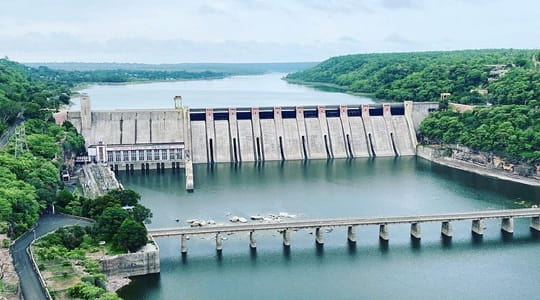
 If you’ve ever wondered how the Chambal River, once notorious purely for its ravines and dacoit legends, turned into one of India’s most important hydroelectric and irrigation systems, Gandhi Sagar Dam is where that transformation genuinely began. This was the first of four major dams built on the Chambal, and it remains India’s third-largest reservoir by area even today. If you’re planning a trip through Madhya Pradesh’s Mandsaur district, here’s everything worth knowing about this genuinely underrated destination.
Quick Overview
| Detail | Information |
| River | Chambal River |
| Location | Mandsaur and Neemuch districts, Madhya Pradesh |
| Distance from Mandsaur | Around 40–65 km (sources vary) |
| Nearest Airport | Indore Airport, about 250 km away |
| Foundation Laid | 7 March 1954, by Prime Minister Jawaharlal Nehru |
| Construction Completed | 1960 (additional structures added through the 1970s) |
| Dam Type | Masonry gravity dam |
| Dam Height | Around 62–64 metres |
| Dam Length | About 513–1,171 metres (sources vary) |
| Gross Storage Capacity | 7.322 billion cubic metres |
| Reservoir Status | Third-largest reservoir in India by area |
| Power Generation | 115–142 MW hydroelectric capacity |
| Surrounded By | Gandhi Sagar Wildlife Sanctuary, notified 1974 |
| Total Project Cost | Around ₹2.3 billion |
| Best Time to Visit | Monsoon, especially right after heavy rain when gates open |
Where Gandhi Sagar Dam Is Located
Gandhi Sagar Dam sits across the Mandsaur and Neemuch districts of Madhya Pradesh, with distances from Mandsaur town reported anywhere from 40 to 65 kilometres depending on the source, and the dam itself situated within a deep gorge section of the Chambal River. Mandsaur connects well by road and rail to major regional cities including Indore, Bhopal, Ujjain, Jaipur, and Kota, making it a reasonable base for planning your visit.
The dam is accessible by motorable road from both Neemuch and Mandsaur, with Bhanpura serving as the local tehsil. Indore Airport, roughly 250 kilometres away, remains the nearest air connection for travellers coming from further afield, though most visitors approach this dam as part of a broader Madhya Pradesh road trip rather than a standalone flight destination.
The River Behind India’s Third-Largest Reservoir
The dam is built across the Chambal River, one of the cleanest perennial rivers in India and a chief tributary of the Yamuna. The Chambal drains a substantial portion of the Malwa region in northwestern Madhya Pradesh, with the river dropping roughly 625 metres between its source near Mhow and the city of Kota, a gradient that made this stretch genuinely ideal for hydroelectric development.
The reservoir created by Gandhi Sagar Dam stretches up to 68 kilometres in length and 26 kilometres in width, drawing from a catchment area of 22,584 square kilometres that includes tributaries like the Shipra, Kalisindh, and Shivna. This scale places Gandhi Sagar’s reservoir as the third-largest in India by area, trailing only the Indira Sagar and Hirakud reservoirs.
A History Rooted in Pre-Independence Planning
Remarkably, the idea for a dam on the Chambal actually dates back to 1927, when Sir Malcolm Hailey, then Governor of the United Provinces, first proposed the concept. It took nearly three decades for that idea to become reality, with the Madhya Pradesh and Rajasthan state governments jointly drawing up a formal three-stage development proposal in 1953.
Prime Minister Jawaharlal Nehru laid the foundation stone on 7 March 1954, and construction of the main dam, carried out by contractor Dwarka Das Agrawal & Associates, was completed by 1960, with power generation and distribution commencing that November. Additional dam structures continued being developed through the 1970s, reflecting the project’s growing scope over time. Gandhi Sagar was the first stage in what became a coordinated three-dam system, later joined by the Rana Pratap Sagar Dam downstream at Rawatbhata in Rajasthan, and ultimately feeding into the Kota Barrage.
What the Chambal Valley Project Achieved
The broader vision behind Gandhi Sagar was genuinely ambitious for its time — harness the Chambal’s substantial elevation drop for hydroelectric power, then use the released water for irrigation via the Kota Barrage, located 104 kilometres downstream. This staged system allowed water to serve double duty, generating electricity first and then supporting agriculture as it continued its journey.
The Kota Barrage alone irrigates 427,000 to 567,000 hectares depending on which development phase figures you reference, with water shared equally between Madhya Pradesh and Rajasthan. Gandhi Sagar’s own power station, fitted with five 23-MW turbines and, according to some sources, an additional 27-MW unit, supplies electricity first to the local district before extending to other regions across both Madhya Pradesh and Rajasthan.
Wildlife Surrounding the Reservoir
The forested wilderness around Gandhi Sagar Dam has been designated the Gandhi Sagar Wildlife Sanctuary, notified in 1974 and later enlarged in 1983, spanning roughly 36,700 hectares shared between Mandsaur and Neemuch districts. This area was historically used as a hunting ground by the Holkar royal family of Indore, and today it’s home to leopards, sloth bears, various deer and antelope species, hyenas, and monkeys.
The reservoir itself falls under the joint control of Madhya Pradesh’s irrigation and fisheries departments, and fisheries development remains one of its ongoing functions alongside power generation and irrigation.
What There Is to See and Do
Boating and fishing are the most popular visitor activities here, with anglers trying their luck for catfish, rohu, and mrigal in the reservoir’s calm waters. Walking across the dam itself rewards visitors with genuinely panoramic views over both the water and the surrounding hills and forest, and several visitor accounts specifically highlight the experience of watching the dam’s gates open during monsoon as one of the most memorable sights in the entire region.
Nearby attractions add real depth to a Gandhi Sagar trip. Jaora, roughly 30 kilometres away, offers ancient Jain temples and historic forts, while the Chambal Ravines showcase a genuinely unique erosion-carved landscape home to crocodiles, gharials, and Indian skimmers. Mandsaur itself, known for its ancient temples and distinctive opium and garlic trade, sits within easy reach, and for those willing to extend their trip further, Maheshwar and Omkareshwar on the Narmada River offer worthwhile additions roughly 120 to 150 kilometres away.
Practical Realities Worth Knowing
Accommodation directly near the dam is genuinely limited, with only a few guest houses run by the forest and irrigation departments available on-site. Most visitors either plan a day trip from Mandsaur, where proper hotels are available, or book a government rest house in advance if they’d prefer to stay closer to the dam itself.
Timings and Best Time to Visit
Visitor accounts consistently point to monsoon season, particularly right after heavy rainfall, as the ideal time to visit, since this is when the dam’s gates are most likely to open, creating a genuinely dramatic water release that’s considered the highlight of any Gandhi Sagar trip. Outside monsoon, the dam remains a pleasant, scenic destination for boating, fishing, and general sightseeing, though without the same spectacle of open floodgates.
Frequently Asked Questions
Q1. Why is Gandhi Sagar Dam historically significant beyond its size?
It was the first of a coordinated three-stage Chambal Valley development project, conceived as far back as 1927 and finally realised through a joint Madhya Pradesh-Rajasthan initiative in the 1950s, making it a foundational piece of one of India’s earliest interstate river development schemes.
Q2. Is Gandhi Sagar Dam suitable for a day trip, or should I plan to stay overnight?
Given limited accommodation options directly at the dam, most visitors plan it as a day trip from Mandsaur, where proper hotels are available, though booking a government rest house in advance works if you’d prefer to stay closer to the site itself.
Q3. What’s the best time to see the dam’s floodgates open?
Right after heavy monsoon rainfall offers the best chance, since this is when water levels typically require gate release, creating what many visitors describe as the most spectacular sight at Gandhi Sagar.
Q4. Can I combine a Gandhi Sagar Dam visit with wildlife spotting?
Yes, the surrounding Gandhi Sagar Wildlife Sanctuary is home to leopards, sloth bears, deer, and antelope species, making it possible to combine your dam visit with some wildlife observation, particularly around the forested catchment areas near the reservoir.